

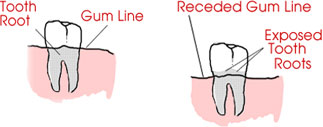
What You Should Do About Sensitive TeethFor millions of people, sensitive teeth can make life miserable. The pain and discomfort make even favorite hot or cold foods impossible to enjoy. All is not lost. In many cases, sensitive teeth can be successfully treated bringing long sought after relief. What Causes Sensitive Teeth (Dentin Hypersensitivity)?Usually tooth sensitivity (dentin hypersensitivity) presents as temporary tooth discomfort or pain after eating cold food, drinking cold liquids, or breathing cold air. ( If the pain is very high in intensity and prolonged, see your dentist because this may be a sign of an unhealthy tooth nerve ) Most commonly, the problem begins when the gums recede. Like a protective blanket, the gums cover the roots of teeth (see diagram below). As gums recede, the underlying tooth roots are exposed. Gums commonly recede for one of two reasons:
Preventing Sensitive Teeth (Dentin Hypersensitivity)The key to preventing tooth sensitivity is to keep the gums from receding. Reducing the pressure we use to brush our teeth helps tremendously. The problem with this is that our tooth brushing is an unconsciously ingrained habit reinforced after decades of brushing and therefore nearly impossible to change. We advise people to use an advanced electric toothbrushes (plaque remover) like the Braun 3D Excel or Sonicare. These toothbrushes feature pressure sensors that stop the brush when you apply too much pressure. Another option is the Alert toothbrush, (part of our Sensitive Teeth Kit) which activates a warning light when you brush too hard. Preventing gingivitis and periodontal disease with proper oral hygiene is also crucial in preventing gum recession. Remember, it takes 2 to 3 minutes to properly brush all your tooth surfaces. Most people spend less than 45 seconds leaving areas untouched where plaque and tartar can build up. Flossing is crucial in order to reach the 35% of the tooth surfaces where brushing can not reach. Treating Sensitive Teeth (Dentin Hypersensitivity)What can you do once you already experience sensitive teeth ? Sensitivity toothpastes containing potassium nitrate can also help reduce tooth sensitivity. Sensodyne is the #1 Dentist recommended toothpaste for sensitive teeth and is part of the our Sensitive teeth Kit. These toothpastes desensitize the tooth nerve directly. Treating teeth with fluoride mouthwashes also can help reduce tooth sensitivity. After a few weeks of use the sensitivity usually goes away. Unfortunately, the same heavy handed brushing which caused the sensitivity in the first place can brush away the pore covers created by the toothpaste. This will cause sensitivity to return. For this reason, we suggest that people use the Alert toothbrush while using sensitivity toothpastes. This combination is found in our Sensitive teeth Kit Additionally, highly acidic foods (citrus, soda pop, tea) can increase sensitivity and work against the sensitivity toothpaste. A major advance in treatment has been the introduction of sensitivity toothpastes containing strontium chloride. These products, like Sensodyne and a host of others, coax the minerals in your saliva to crystallize and cover the pores in your exposed roots so that cold stimuli can not reach the tooth nerve. If you cannot get relief by brushing gently and using sensitivity toothpaste, your dentist has several options for relief. Your dentist can use "oxalate" compounds that, when rubbed on the root, will reduce if not eliminate the sensitivity. Many dentists prescribe high fluoride content mouthwashes which can help reduce tooth sensitivity. Dentists may also apply "bonding agents" to close the pores of the tooth root. Learn How The Alert Toothbrush Prevents Sensitive Teeth
|
 Delicious
 Digg
Digg Reddit
 Stumbleupon
 Facebook
 Google Bookmarks
 Yahoo My Web
 Technorati
 Blogmarks
 BlinkList
 Spurl
Spurl Diigo
Diigo
Copyright © 2007 - 2010 Your Customer Service Home SaveYourSmile. All Rights Reserved.
SaveYourSmile Inc, 5440 North 6th Str, Philadelphia, PA,19120, 1-888-891-1326
Disclaimer: The information contained within is for educational purposes only. It is not meant to serve as delivery of medical care.
Those persons with specific medical questions should consult their dentist, doctor, or other medical care provider.
